Entities are the essential part of WorldSystem. More...
#include <Entity.hpp>
Public Member Functions | |
| Entity ()=default | |
| Entity (entt::handle handle) | |
| template<typename T, typename... Args> | |
| T & | AddComponent (Args &&... args) |
| Adds a component to the entity. | |
| template<typename T, typename... Args> | |
| T & | ReplaceComponent (Args &&... args) |
| Replaces the component with a newly created one. | |
| template<typename T, typename... Args> | |
| T & | AddOrReplaceComponent (Args &&... args) |
| Adds a component to the entity, or replaces it if the entity already has this component. | |
| template<typename... T> | |
| decltype(auto) | GetComponents () |
| Retries the references to the requested components of the entity. | |
| template<typename... T> | |
| decltype(auto) | GetComponents () const |
| Retries the references to the requested components of the entity. Const variant. | |
| template<typename T, typename... Args> | |
| T & | GetOrAddComponent (Args &&... args) |
| Retries or adds a component to the entity. | |
| template<typename... T> | |
| bool | HasComponents () const |
| Checks if the entity has all the specified components. | |
| template<typename... T> | |
| entt::handle::size_type | RemoveComponents () |
| Removes components from the entity if entity has them. | |
| template<typename... T> | |
| void | EraseComponents () |
| Erases components from the entity without checking if the entity actually have them. | |
| operator bool () const | |
| bool | operator== (const Entity &other) const |
| bool | operator!= (const Entity &other) const |
| bool | IsValid () const |
| Checks if the actual entity behind this handle is valid. | |
| void | SetActive (const bool state) |
| Changes the activity state of the entity. | |
| bool | IsActiveLocally () const |
| Checks if the entity is active locally (doesn't have InactiveLocallyFlag), just a convenience function. | |
| bool | IsActiveGlobally () const |
| Checks if the entity is active locally (doesn't have InactiveGloballyFlag), just a convenience function. | |
| uint32_t | GetID () const |
| Gets the entity ID. | |
| uint32_t | GetVersion () const |
| Gets the entity version. | |
| uint64_t | GetEUID () const |
| Gets the EUID (entity unique ID). A combination of entity ID and version, it is unique for every entity. | |
| uint32_t | GetOwnerSceneID () const |
| Retries the ID of the owner scene. You can get the actual SceneHandle by providing SceneManager with this ID (method: GetHandle). | |
| std::string | GetDebugData (bool showUUID=false) const |
| Gets the debuting string for logging. | |
| std::expected< void, Core::CoriError<> > | SetParent (Entity parent) |
| Links the entity to a parent entity. | |
| std::expected< std::vector< Entity >, Core::CoriError<> > | GetSiblings () const |
| Creates and returns a vector containing all entity siblings. | |
| std::expected< Entity, Core::CoriError<> > | GetParent () const |
| Retries the parent entity of the entity if any. | |
| std::expected< std::vector< Entity >, Core::CoriError<> > | GetChildren () const |
| Creates and returns a vector containing all entity children (does not include grandchildren and so on, not recursive). | |
| std::expected< Entity, Core::CoriError<> > | FindChildByName (const char *name) const |
| Finds a children entity by name. | |
| std::expected< Entity, Core::CoriError<> > | FindChildByName (const std::string_view name) const |
| Finds a children entity by name. | |
| std::expected< Entity, Core::CoriError<> > | FindChildByName (const std::string &name) const |
| Finds a children entity by name. | |
| void | DestroyChildren () |
| Destroys all children (and they grandchildren) that the entity has. | |
| entt::entity | GetRawEntity () const |
| Gets a raw entt::entity if you need to interact with entt directly. | |
| entt::handle | GetRawHandle () const |
| Gets a raw entt::handle if you need to interact with entt directly. | |
| void | PrintHierarchy () const |
| Prints the full entity hierarchy tree in the console. | |
| std::string_view | GetName () const |
| Retrieves the name of the entity. | |
| void | SetName (const std::string &name) |
| Changes the entity name. | |
| void | UnlinkFromParent () |
| Unlinks the entity from its parent if it has one. | |
Protected Member Functions | |
| void | UpdateInactivityFlagsRecursive (entt::entity parent, bool parentIsActive) |
Friends | |
| class | Scene |
Detailed Description
Entities are the essential part of WorldSystem.
Entities can have a parent-children hierarchy that is represented by a left-child right-sibling binary tree internally.
Instance of Entity class does not control a lifetime of an actual entity, it lifetime is controlled by the Scene. Through this class you interact with an actual entity, it is sort of a now-owning handle.
Definition at line 25 of file Entity.hpp.
Constructor & Destructor Documentation
◆ Entity() [1/2]
|
default |
◆ Entity() [2/2]
|
inline |
Definition at line 29 of file Entity.hpp.
Member Function Documentation
◆ AddComponent()
|
inline |
Adds a component to the entity.
- Template Parameters
-
T Type of component to add. Args Deduced automatically, no need to specify.
- Parameters
-
args Arguments passed to the component constructor.
- Returns
- A reference to the newly created component.
Definition at line 39 of file Entity.hpp.
◆ AddOrReplaceComponent()
|
inline |
Adds a component to the entity, or replaces it if the entity already has this component.
- Template Parameters
-
T Type of component to add or replace. Args Deduced automatically, no need to specify.
- Parameters
-
args Arguments passed to the component constructor.
- Returns
- A reference to the newly created or replaced component.
Definition at line 63 of file Entity.hpp.
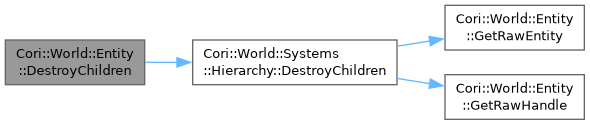
◆ DestroyChildren()
| void Cori::World::Entity::DestroyChildren | ( | ) |
Destroys all children (and they grandchildren) that the entity has.
Definition at line 106 of file Entity.cpp.
◆ EraseComponents()
|
inline |
Erases components from the entity without checking if the entity actually have them.
- Template Parameters
-
T Components to erase.
- Warning
- This method is dangerous, call it only when you absolutely sure that the entity has all the components you're trying to erase, if at least one component is absent it will cause a crash.
Definition at line 144 of file Entity.hpp.
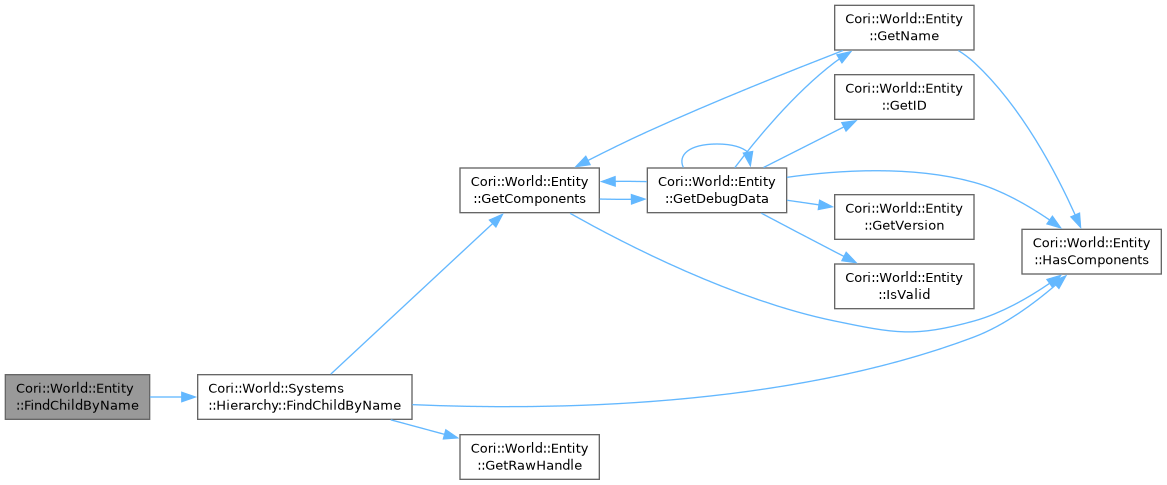
◆ FindChildByName() [1/3]
|
nodiscard |
Finds a children entity by name.
- Parameters
-
name Name of the children to find.
- Returns
- Expected object with child entity with the specified name, or CoriError<> on failure.
Definition at line 94 of file Entity.cpp.
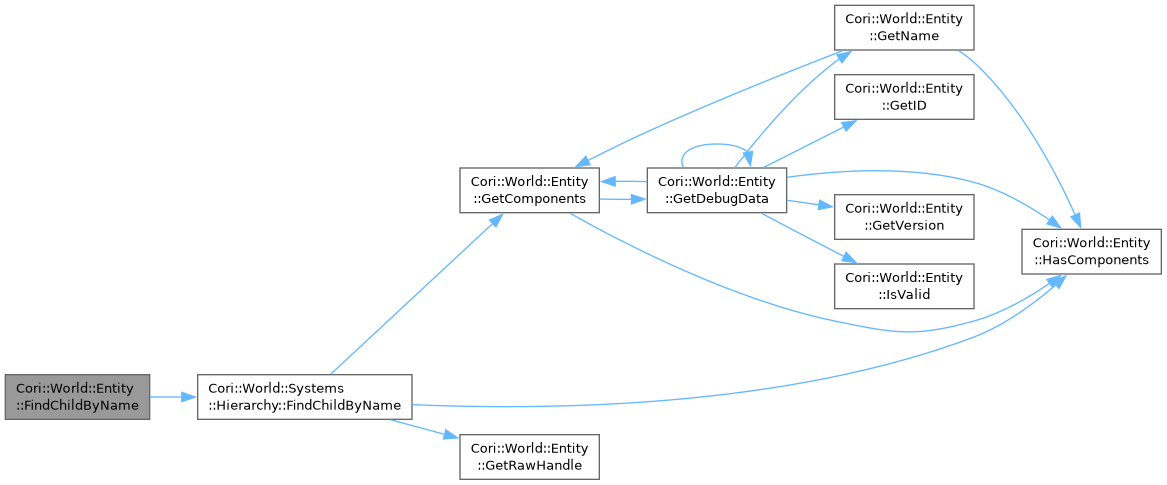
◆ FindChildByName() [2/3]
|
nodiscard |
Finds a children entity by name.
- Parameters
-
name Name of the children to find.
- Returns
- Expected object with child entity with the specified name, or CoriError<> on failure.
Definition at line 102 of file Entity.cpp.
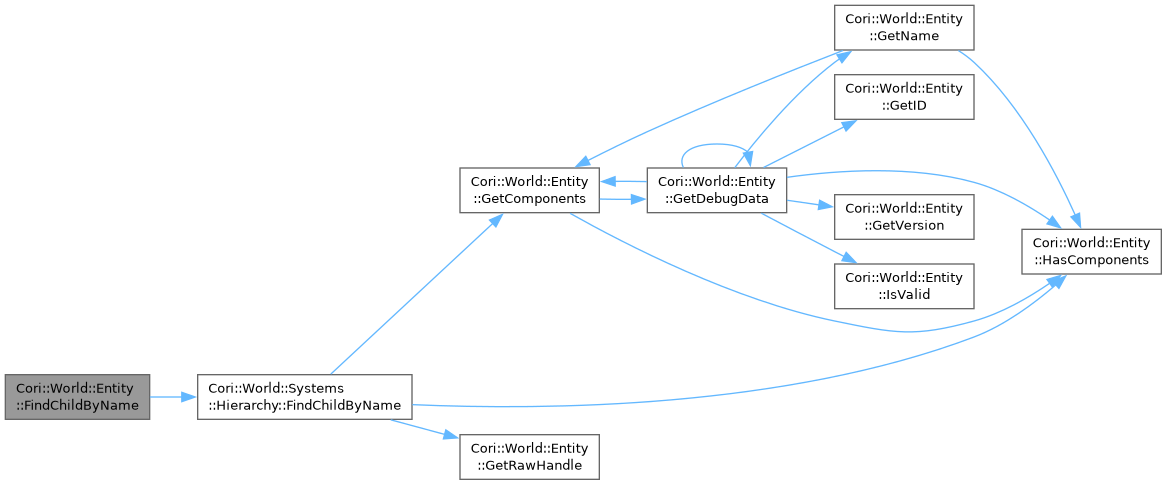
◆ FindChildByName() [3/3]
|
nodiscard |
Finds a children entity by name.
- Parameters
-
name Name of the children to find.
- Returns
- Expected object with child entity with the specified name, or CoriError<> on failure.
Definition at line 98 of file Entity.cpp.
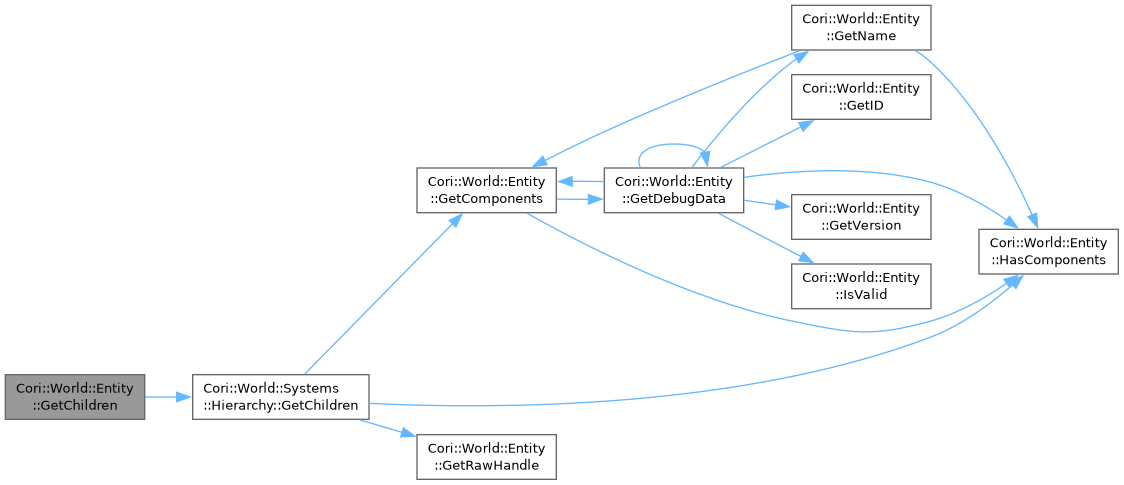
◆ GetChildren()
|
nodiscard |
Creates and returns a vector containing all entity children (does not include grandchildren and so on, not recursive).
- Returns
- Expected object with a vector of all children, or CoriError<> on failure.
Definition at line 90 of file Entity.cpp.
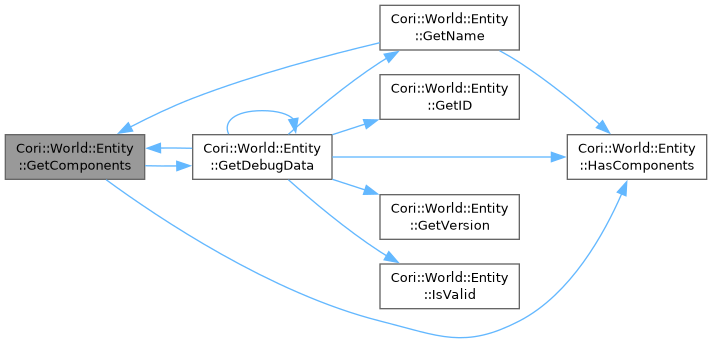
◆ GetComponents() [1/2]
|
inlinenodiscard |
Retries the references to the requested components of the entity.
- Template Parameters
-
T Types of components to retrieve.
- Note
- When retrieving multiple components use structured binding. Also make sure you use receive by reference not by value.
- Returns
- References to the requested component(s).
Definition at line 74 of file Entity.hpp.
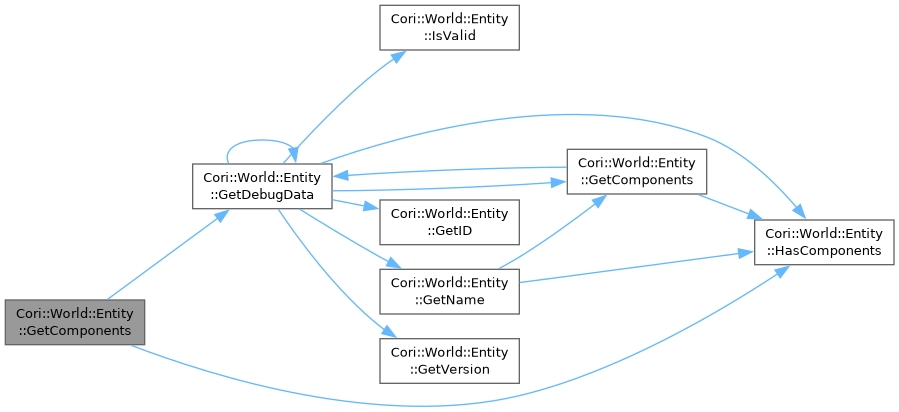
◆ GetComponents() [2/2]
|
inlinenodiscard |
Retries the references to the requested components of the entity. Const variant.
- Template Parameters
-
T Types of components to retrieve.
- Note
- When retrieving multiple components use structured binding. Also make sure you use receive by const reference not by value.
- Returns
- References to the requested component(s).
Definition at line 92 of file Entity.hpp.
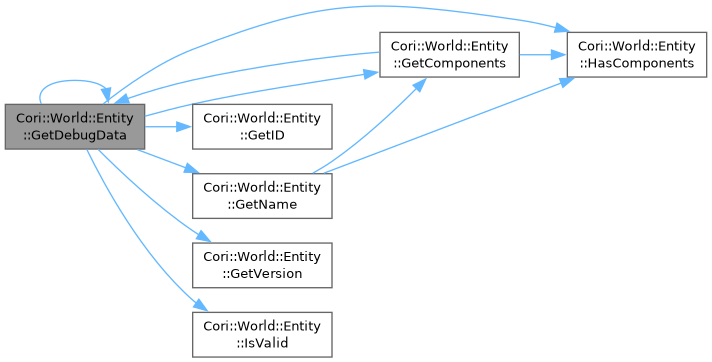
◆ GetDebugData()
|
nodiscard |
Gets the debuting string for logging.
- Parameters
-
showUUID Whether to include UUID in the debugging string.
- Returns
- Formated debugging string.
Definition at line 65 of file Entity.cpp.
◆ GetEUID()
|
inlinenodiscard |
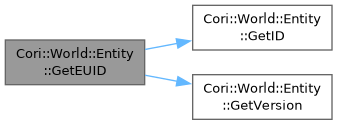
Gets the EUID (entity unique ID). A combination of entity ID and version, it is unique for every entity.
- Returns
- EUID.
Definition at line 205 of file Entity.hpp.
◆ GetID()
|
inlinenodiscard |
Gets the entity ID.
- Returns
- Entity ID.
- Note
- Entity IDs can be reused, to differentiate one entity from the other, you need to compare entity ID and entity version. To get a unique entity ID use GetEUID() method.
Definition at line 189 of file Entity.hpp.
◆ GetName()
|
nodiscard |
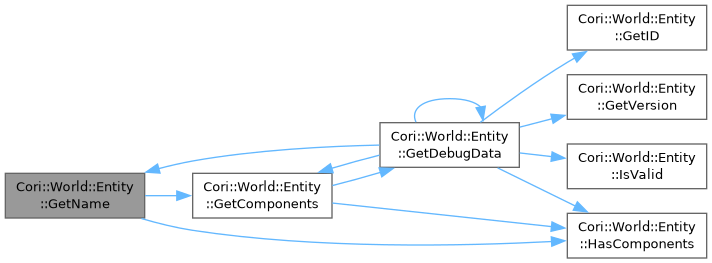
Retrieves the name of the entity.
- Returns
- A view to the current entity name.
Definition at line 114 of file Entity.cpp.
◆ GetOrAddComponent()
|
inline |
Retries or adds a component to the entity.
- Template Parameters
-
T Type of component to retrieve or add if absent. Args Deduced automatically, no need to specify.
- Parameters
-
args Arguments passed to the component constructor in case of addition of the component.
- Returns
- Reference to the added or received component.
Definition at line 112 of file Entity.hpp.
◆ GetOwnerSceneID()
|
inlinenodiscard |
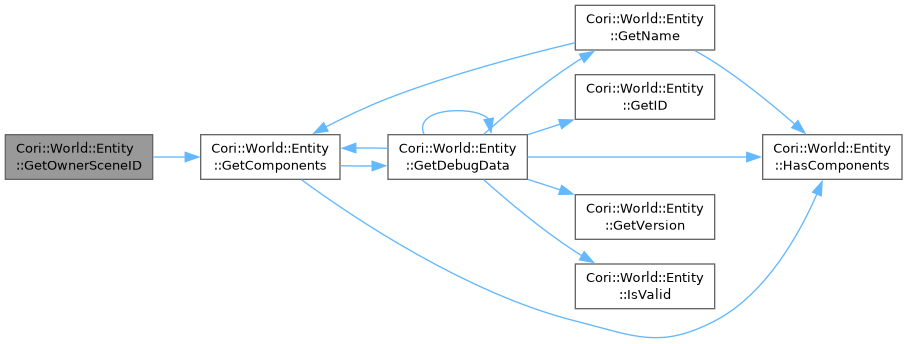
Retries the ID of the owner scene. You can get the actual SceneHandle by providing SceneManager with this ID (method: GetHandle).
- Returns
- Owner SceneID.
Definition at line 213 of file Entity.hpp.
◆ GetParent()
|
nodiscard |
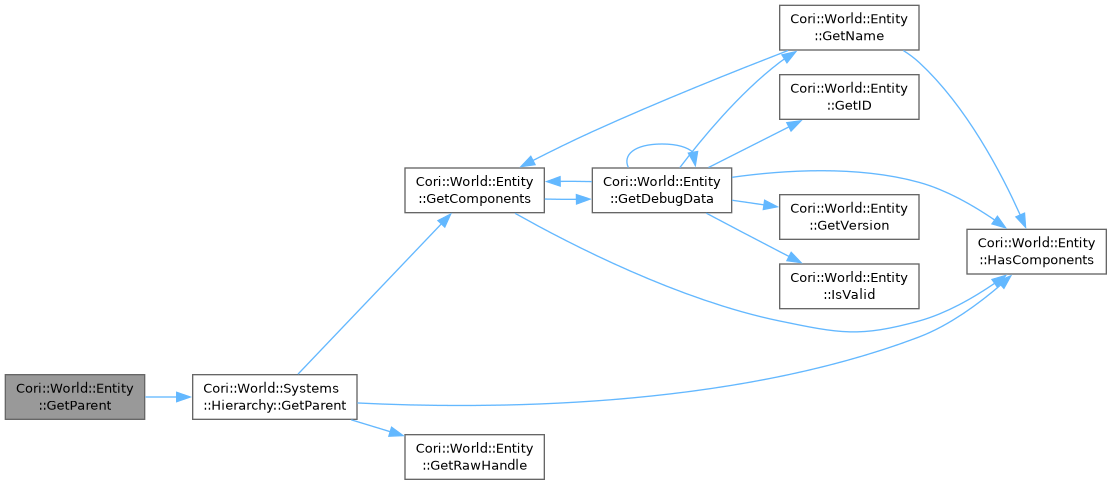
Retries the parent entity of the entity if any.
- Returns
- Expected object with the parent entity, or CoriError<> on failure.
Definition at line 82 of file Entity.cpp.
◆ GetRawEntity()
|
inlinenodiscard |
Gets a raw entt::entity if you need to interact with entt directly.
- Returns
- Underlying entt::entity.
- Warning
- Use at your own risk and only if you know what you're doing.
Definition at line 280 of file Entity.hpp.
◆ GetRawHandle()
|
inlinenodiscard |
Gets a raw entt::handle if you need to interact with entt directly.
- Returns
- Underlying entt::handle.
- Warning
- Use at your own risk and only if you know what you're doing.
Definition at line 287 of file Entity.hpp.
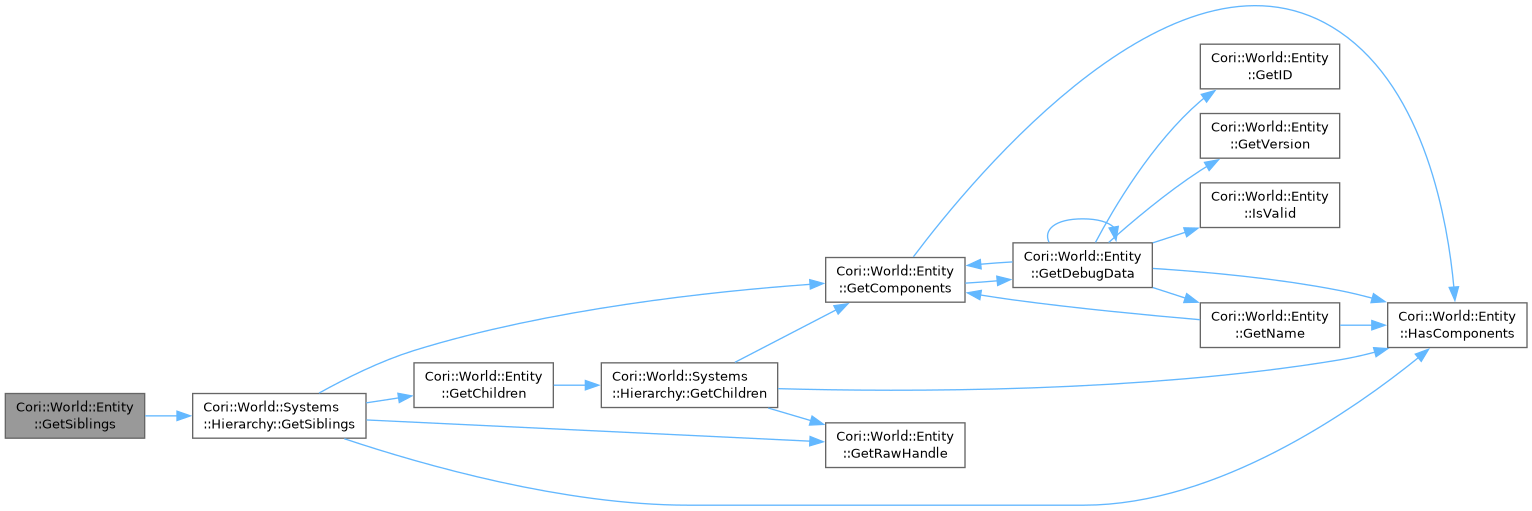
◆ GetSiblings()
|
nodiscard |
Creates and returns a vector containing all entity siblings.
- Returns
- Expected object with a vector of siblings, or CoriError<> on failure.
Definition at line 86 of file Entity.cpp.
◆ GetVersion()
|
inlinenodiscard |
◆ HasComponents()
|
inlinenodiscard |
Checks if the entity has all the specified components.
- Template Parameters
-
T Components to check the presence of.
- Returns
- True if the entity has all the components, false if at least one is absent.
Definition at line 122 of file Entity.hpp.
◆ IsActiveGlobally()
|
nodiscard |
Checks if the entity is active locally (doesn't have InactiveGloballyFlag), just a convenience function.
- Returns
- True if it doesn't have InactiveGloballyFlag, false otherwise.
Definition at line 61 of file Entity.cpp.

◆ IsActiveLocally()
|
nodiscard |
Checks if the entity is active locally (doesn't have InactiveLocallyFlag), just a convenience function.
- Returns
- True if it doesn't have InactiveLocallyFlag, false otherwise.
Definition at line 57 of file Entity.cpp.

◆ IsValid()
|
inlinenodiscard |
Checks if the actual entity behind this handle is valid.
- Returns
- True if valid, false otherwise.
Definition at line 161 of file Entity.hpp.
◆ operator bool()
|
inlineexplicit |
Definition at line 148 of file Entity.hpp.
◆ operator!=()
|
inline |

◆ operator==()
|
inline |

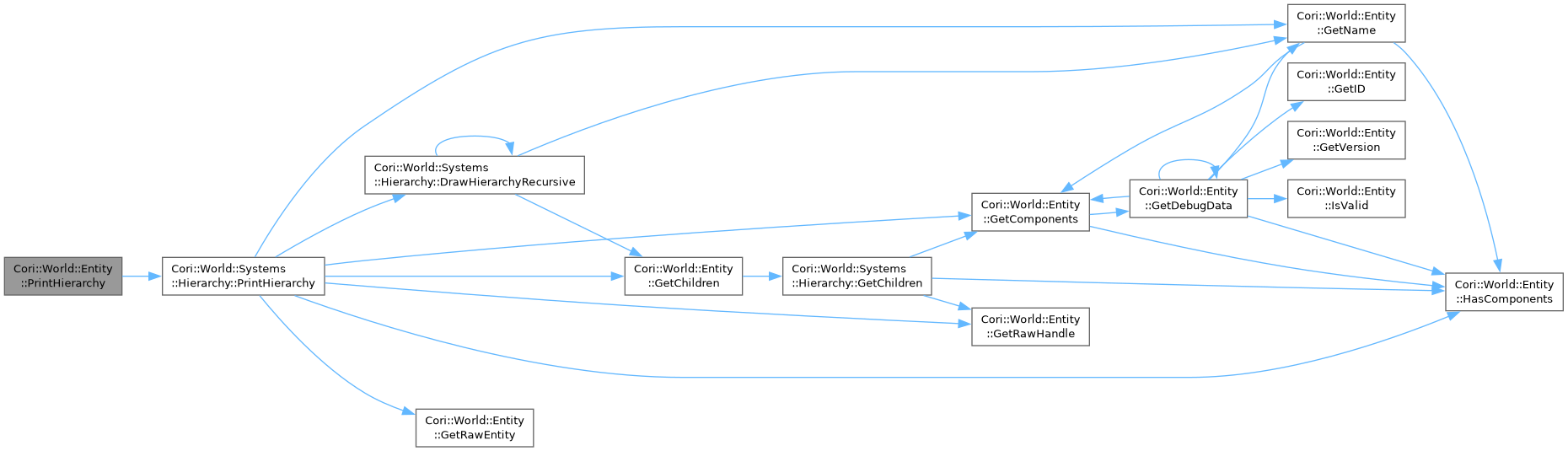
◆ PrintHierarchy()
| void Cori::World::Entity::PrintHierarchy | ( | ) | const |
Prints the full entity hierarchy tree in the console.
Definition at line 110 of file Entity.cpp.
◆ RemoveComponents()
|
inline |
Removes components from the entity if entity has them.
- Template Parameters
-
T Components to remove.
- Note
- Removes the components only if the entity has it, it's safe to try to remove a component that the entity doesn't have.
- Returns
- Amount of components removed.
Definition at line 133 of file Entity.hpp.
◆ ReplaceComponent()
|
inline |
Replaces the component with a newly created one.
- Template Parameters
-
T Type of component to replace. Args Deduced automatically, no need to specify.
- Parameters
-
args Arguments passed to the component constructor.
- Returns
- A reference to the replaced component.
Definition at line 51 of file Entity.hpp.
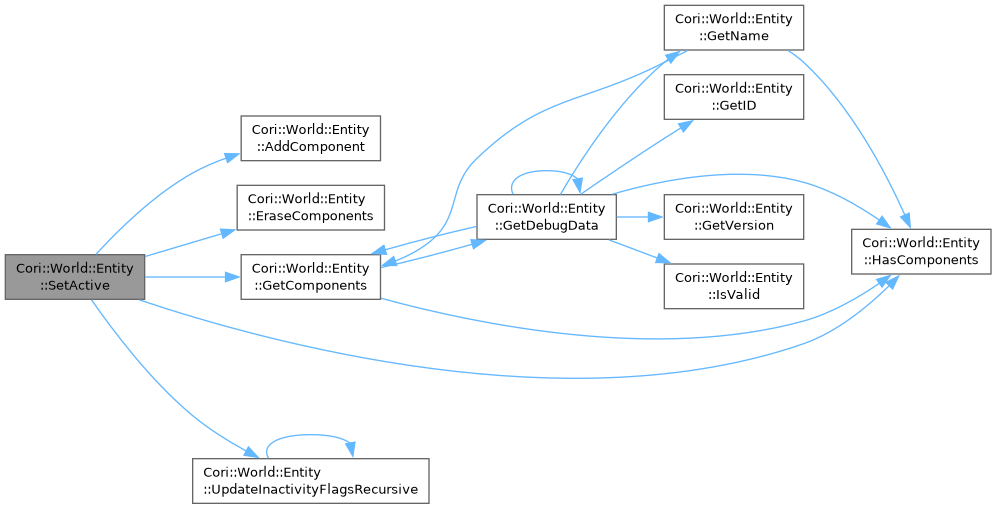
◆ SetActive()
| void Cori::World::Entity::SetActive | ( | const bool | state | ) |
Changes the activity state of the entity.
- Parameters
-
state Activity state to set.
When deactivating the entity a InactiveLocallyFlag and InactiveGloballyFlag are assigned to it, it this entity has any children a InactiveGloballyFlag will be added to the whole children tree recursively (to the grandchildren, grand-grandchildren and so on).
Definition at line 7 of file Entity.cpp.
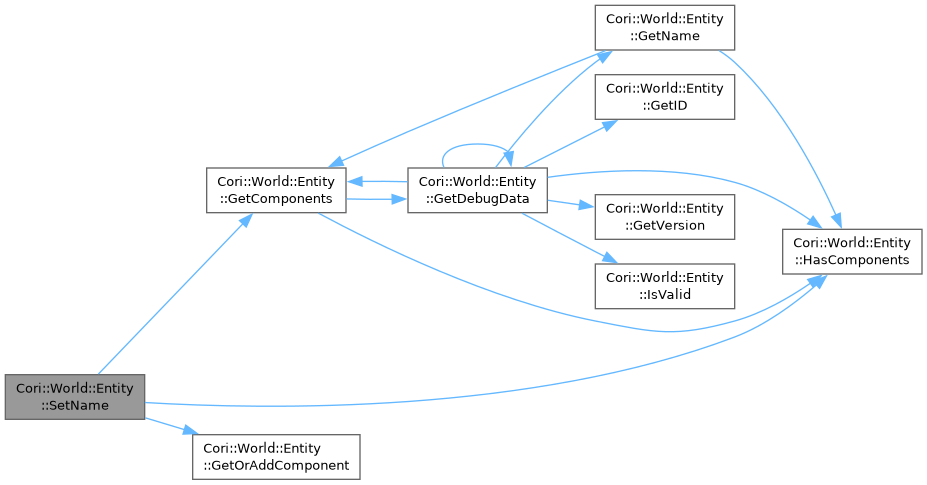
◆ SetName()
| void Cori::World::Entity::SetName | ( | const std::string & | name | ) |
Changes the entity name.
- Parameters
-
name Name to change to.
Definition at line 122 of file Entity.cpp.
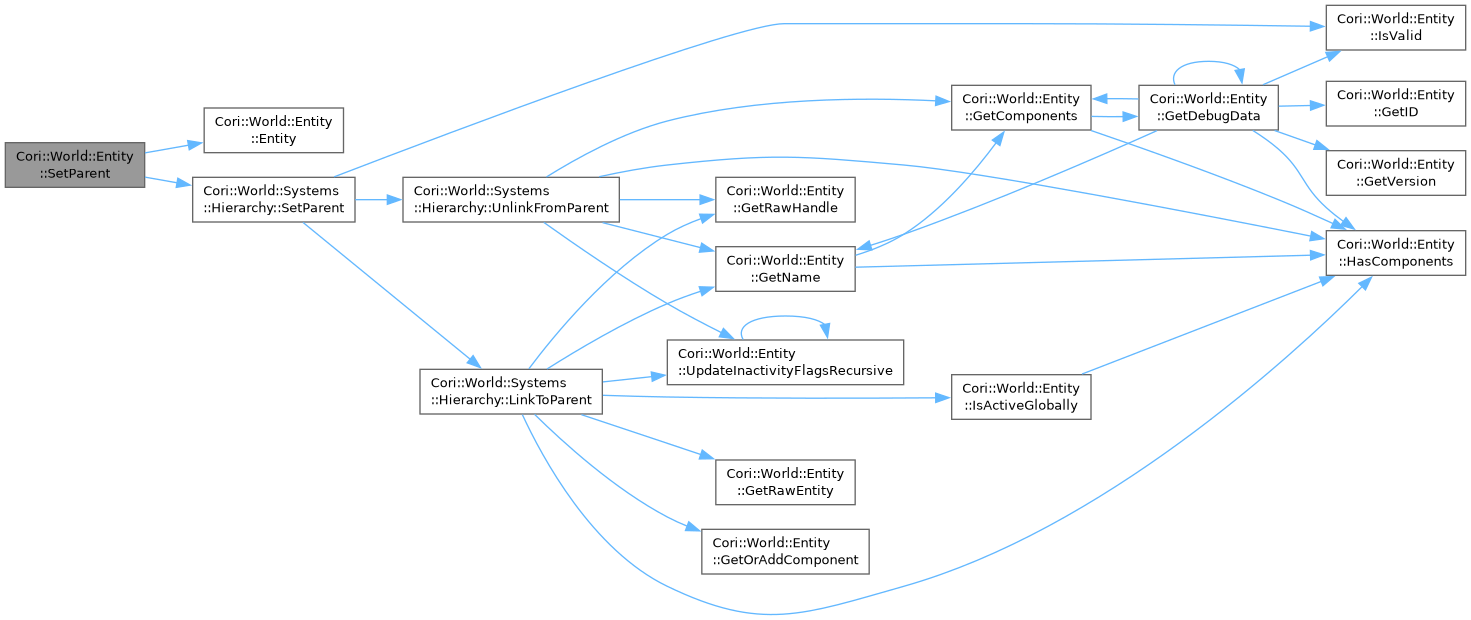
◆ SetParent()
| std::expected< void, Core::CoriError<> > Cori::World::Entity::SetParent | ( | Entity | parent | ) |
Links the entity to a parent entity.
- Parameters
-
parent Parent entity to link the entity to.
- Returns
- Expected object with void on success or CoriError<> on failure.
Definition at line 78 of file Entity.cpp.
◆ UnlinkFromParent()
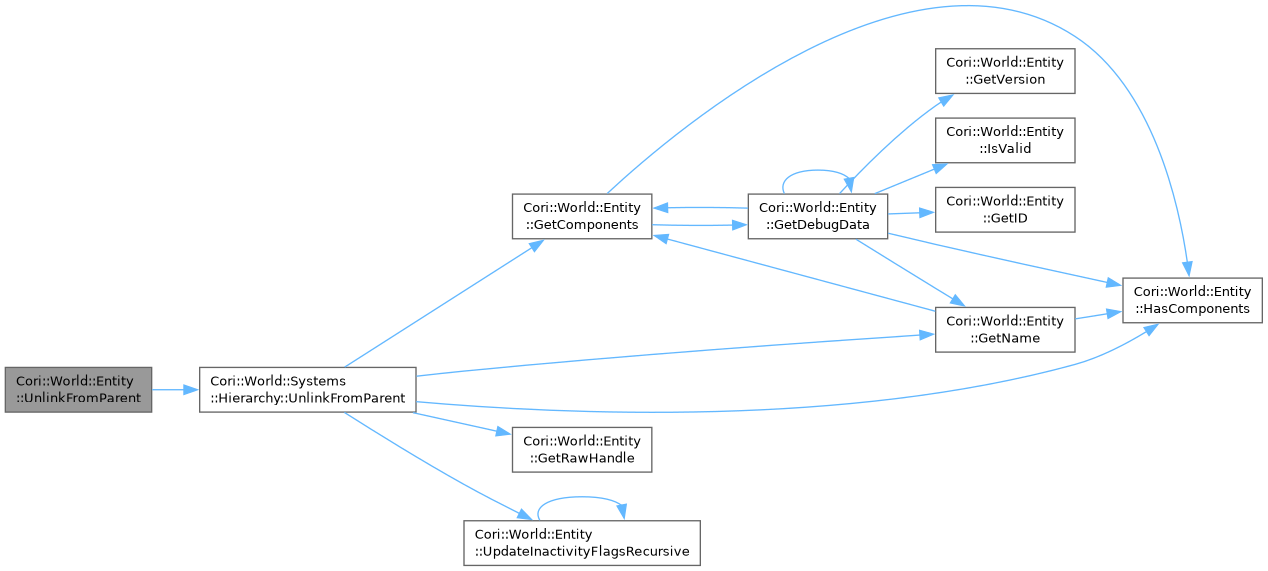
| void Cori::World::Entity::UnlinkFromParent | ( | ) |
Unlinks the entity from its parent if it has one.
Definition at line 143 of file Entity.cpp.
◆ UpdateInactivityFlagsRecursive()
|
protected |
Friends And Related Symbol Documentation
◆ Scene
|
friend |
Definition at line 319 of file Entity.hpp.
The documentation for this class was generated from the following files: