#include <System.hpp>
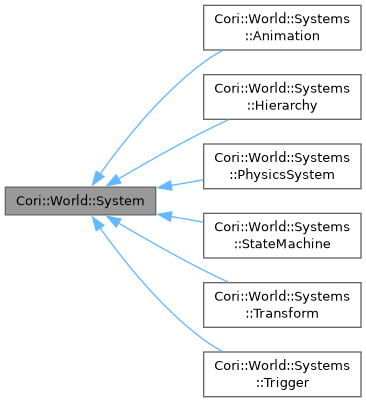
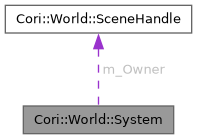
Public Member Functions | |
| virtual | ~System ()=default |
| System (const System &)=delete | |
| System & | operator= (const System &)=delete |
| System (System &&)=delete | |
| System & | operator= (System &&)=delete |
| virtual void | OnUpdate (Core::GameTimer &gameTimer) |
| virtual void | OnTickUpdate (Core::GameTimer &gameTimer) |
| virtual void | OnImGuiRender (Core::GameTimer &gameTimer) |
Protected Member Functions | |
| System ()=default | |
Protected Attributes | |
| SceneHandle | m_Owner { nullptr } |
Detailed Description
System part of ECS.
Systems are a crucial part of the world and scene, I'm not going to describe what systems are in an ECS scope, you can google that.
In Cori, you can register, unregister systems for the scene, a scene can only have one instance of a particular system.
Systems can have a specific priority to them, that way you can control what systems are updated first.
To define a system you need to:
1: Derive from this class.
2: Create a method 'Create' that can take any amount of arguments and returns a bool. If 'Create' returns false the system will not be registered for the scene.
3: A static public member of type 'SystemPriority' named 'Priority'
- Warning
- You should put all your initialization code into the 'Create' method, because m_Owner (SceneHandle) is only valid after the constructor has run.
Definition at line 22 of file System.hpp.
Constructor & Destructor Documentation
◆ ~System()
|
virtualdefault |
◆ System() [1/3]
|
delete |
◆ System() [2/3]
|
delete |
◆ System() [3/3]
|
protecteddefault |
Member Function Documentation
◆ OnImGuiRender()
|
inlinevirtual |
Definition at line 35 of file System.hpp.
◆ OnTickUpdate()
|
inlinevirtual |
Reimplemented in Cori::World::Systems::Animation, Cori::World::Systems::PhysicsSystem, Cori::World::Systems::StateMachine, and Cori::World::Systems::Trigger.
Definition at line 33 of file System.hpp.
◆ OnUpdate()
|
inlinevirtual |
Reimplemented in Cori::World::Systems::Transform.
Definition at line 31 of file System.hpp.
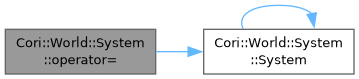
◆ operator=() [1/2]
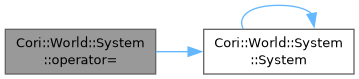
◆ operator=() [2/2]
Member Data Documentation
◆ m_Owner
|
protected |
Definition at line 38 of file System.hpp.
The documentation for this class was generated from the following files: